
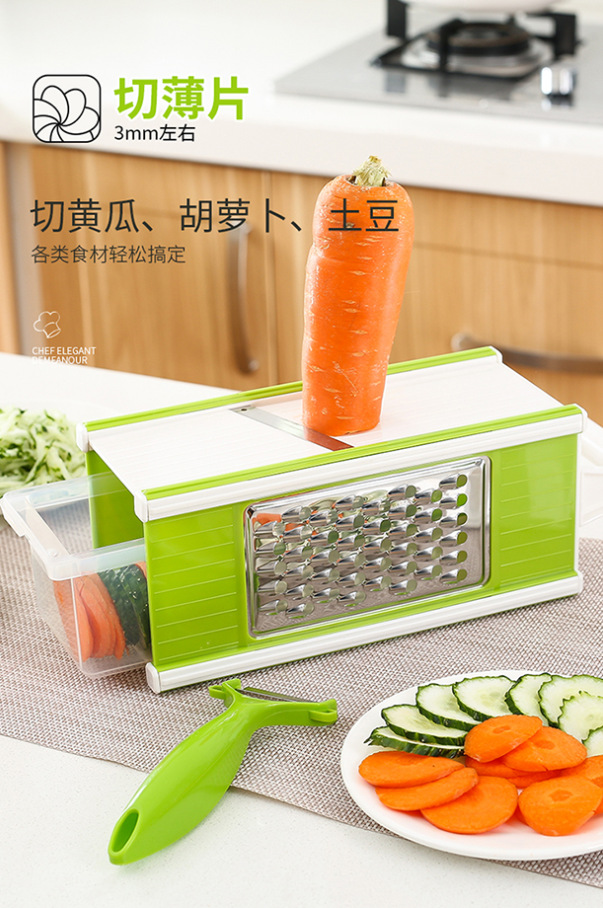
Becoming a kitchen gadgets distributor is one of the most accessible entry points into wholesale. You do not need a warehouse on day one, the products are compact and inexpensive to ship, and demand is driven by everyday cooking habits rather than seasonal hype. But the difference between a profitable distributor and a room full of unsold inventory usually comes down to the decisions you make before placing your first order. This guide walks through those decisions: choosing a product range, evaluating suppliers, running the margin math, placing a test order, and picking sales channels.
Step 1: Define Your Product Range
New distributors often make the mistake of buying whatever looks like a bargain. A stronger approach is to define a tight product range built around a clear customer. Three common starting profiles work well:
- The everyday-cook range: vegetable peelers, choppers, garlic presses, measuring tools. Low price points, high repeat demand, easy to demonstrate.
- The prep-and-storage range: containers, silicone lids, drawer organizers, produce keepers. Slightly higher ticket sizes and strong bundle potential.
- The problem-solver range: multi-tools that replace a bulky appliance or fix one kitchen annoyance. These win on demonstration and are ideal if you sell through social or video channels.
Aim for 10 to 20 SKUs to start. That is enough to offer variety and build bundle offers, but small enough that a slow seller cannot trap much of your capital. Avoid oversized items like large appliances in your first range; they raise freight and storage costs without adding much margin per unit.
Step 2: Evaluate Suppliers the Right Way
Your supplier relationship is the backbone of the business. Before committing to anyone, run through this checklist for each candidate:
- MOQ (minimum order quantity): starter-friendly suppliers accept test orders of 50-200 units per SKU. If the MOQ is 1,000+ per SKU for your first buy, keep looking.
- Lead times: ask for production lead time and shipping time separately. A supplier who quotes “25 days” may mean production only, with freight adding two more weeks.
- Private label options: can they print your logo on the product or packaging? Custom packaging usually adds 5-10 days to the lead time, so factor that into planning.
- Sample policy: serious suppliers ship samples at a small fee or credit it against your first order. Never skip samples.
- Defect and rework policy: get the defective-rate tolerance in writing (under 2% is a reasonable ask) and agree on how replacements are handled.
Order samples from at least three suppliers before you choose. Test them in an actual kitchen for a week: does the blade dull, does the handle crack, does the hinge survive 200 uses? Your customers will do exactly this.
Step 3: Run the Margin Math Before You Buy
All numbers below are illustrative. Your real costs will differ, but the method is what matters. Map every cost per unit:
| Cost item | Example value | What it covers |
|---|---|---|
| Unit purchase price | $1.80 | Factory or wholesale price per unit |
| Freight share | $0.45 | Sea or air freight divided across the order |
| Import duties and fees | $0.20 | Duties, customs brokerage, handling |
| Storage and overhead | $0.15 | Warehouse space, staff, software |
| Returns and defects allowance | $0.12 | Refunds, replacements, dead stock buffer |
| Total landed cost | $2.72 | What you actually paid per unit |
As a distributor, you typically sell to retailers or resellers at 2x to 2.5x your landed cost. At 2.5x, a $2.72 landed cost gives a wholesale price of about $6.80, leaving roughly $4.08 per unit of gross profit (about 60% wholesale margin). The retailer then sells to consumers at double or more of your wholesale price, which is how the familiar 50%+ retail margin model works end to end. If the math does not hold at a 2x multiple, the product does not work as a wholesale item no matter how good it looks.
Step 4: Place a Test Order, Not a Launch Order
Your first real order should be designed to produce data, not revenue. Buy the minimum across your 10-20 SKUs and run them through every sales channel you plan to use for 30 to 60 days. Track three numbers per SKU: sell-through rate, return rate, and margin after all costs. Typical test order sizes run from $1,000 to $3,000 total for first-time distributors (illustrative range).
Then rank your SKUs into three tiers:
- Winners: fast sell-through, low returns. Double down on these with your second order.
- Slow but steady: decent margins, modest velocity. Keep small quantities or bundle them with winners.
- Duds: high returns or no movement. Discontinue, even if you personally like the product.
This single habit, cutting duds after one test cycle, is what separates distributors who last from those who slowly accumulate a warehouse of regrets.
Step 5: Choose Your Sales Channels
Kitchen gadgets sell through demonstration, so channels where you can show the product outperform plain listings. Common options for new distributors:
- Direct to small retailers: independent kitchen shops, gift stores, and market stalls buy regularly and pay faster than chains. Start with 20 target stores and work the list.
- Resellers and sub-distributors: other sellers who move volume but do not want to handle sourcing. Offer them tiered pricing that rewards bigger orders.
- Online marketplaces: you can also sell directly to consumers on marketplaces while your wholesale book builds. Read this reseller buying guide for kitchen gadgets for the buy-side view of the same market.
- Social and live selling: short demos of a gadget solving one annoying kitchen task convert well. This is also the channel where a private label line builds recognition fastest.
Pick two channels to start, not five. You will learn each channel’s real margins and return rates much faster with focus.
Step 6: Decide Whether to Private Label Early
Private labeling adds cost and lead time, so most starter distributors begin with neutral packaging and add their brand once a SKU proves itself. The usual pattern: test with generic packaging, then private-label the winners. As a rule of thumb (illustrative), plan for an extra 10-15% on unit cost and an extra 1-2 weeks of lead time for custom packaging at starter volumes. The payoff is pricing power: a branded product is harder for competitors to undercut and easier to build a repeat-customer base around.
Frequently Asked Questions
How much capital does a kitchen gadgets distributor need to start?
Many starters launch with $2,000 to $5,000 (illustrative), covering samples, a small test order, basic storage, and shipping materials. The bigger risk is not the starting amount but tying it up in one oversized first order instead of testing.
What is a reasonable MOQ for a first order?
Look for suppliers who accept 50 to 200 units per SKU on starter orders (illustrative). This is large enough to test the market and small enough that a dud SKU costs you tens of dollars, not hundreds.
What wholesale margin should I target on kitchen gadgets?
Aim for 50% to 60% gross margin on your wholesale price after all landed costs (illustrative). If you need to push past 2.5x landed cost to hit your target, the supplier is likely too expensive.
Do I need a warehouse to be a kitchen gadgets distributor?
No. Kitchen gadgets are small and light, so most starters begin from a spare room or a small storage unit and only move to a warehouse when order volume makes daily packing unmanageable.
Should I private label from the start?
Generally not. Test with neutral packaging, identify your winners over 30 to 60 days, then private label only those. Private labeling an untested product locks capital into a gamble.
Where do new distributors find their first retail customers?
Local independent kitchen and gift shops are the classic first customers. Visit with samples and a one-page price list, offer low opening minimums, and follow up within a week. Your first ten accounts usually come from direct visits, not cold outreach.
Get Started With the Right Wholesale Partner
Becoming a kitchen gadgets distributor comes down to five moves: a tight 10-20 SKU range, supplier vetting with samples, margin math on landed cost, a small test order, and two focused sales channels. Private labeling and expansion come after the data says yes. If you want to skip the supplier hunt and source from a single partner with distributor-friendly minimums and private label options, start at the Skyrocs wholesale program and build your first test order from a catalog already priced for wholesale margins.