
Avocados are a kitchen staple, but prepping one with a standard chef’s knife is one of the most injury-prone jobs you can do at the cutting board. Emergency rooms see plenty of these cases every year: a slipped knife, a stubborn pit, and a deep cut to the hand that was holding the fruit steady.
The issue is not that a knife cannot cut an avocado. Every step of the standard method asks your non-knife hand to hold a round, slippery fruit still while a blade moves toward your palm. This article compares avocado slicer vs knife safety stage by stage, with practical tips for whichever tool you reach for.
What “Avocado Hand” Actually Is
“Avocado hand” is the nickname emergency room staff use for a distinctive injury: a deep cut to the palm or fingers when a knife slips off the hard pit or through the soft flesh and lands in the hand gripping the fruit.
The typical story: someone halves an avocado, tries to remove the pit with the heel of a chef’s knife, and the knife slips. The wound often needs stitches and costs weeks of one-handed living. The lesson: almost every one of these injuries pairs a sharp knife with a hand positioned where the blade can land. Remove either factor and the risk collapses.
Stage 1: Halving the Avocado
To halve an avocado with a knife, you hold the fruit in your palm and run the blade around the pit in a full circle. The fruit is round, the skin can be bumpy, and ripe flesh is soft enough to shift under pressure. One awkward slip and the blade travels across your fingers.
A safer technique helps: set the avocado on the cutting board and hold it from above with tucked fingers, cutting around the middle rather than slicing down toward your palm. But most people still grip it in hand, because that is how the recipe videos show it.
A slicer’s serrated edge halves the fruit just as well. Either way, the rule stands: never cut toward the hand that holds the fruit.
Stage 2: Removing the Pit – The Danger Zone
Pitting is where most injuries happen. The standard knife method is to strike the pit with the heel of the blade so it embeds, then twist to free it. Three things can go wrong, and all three are common:
- The knife misses the pit and hits your thumb or palm instead.
- The blade fails to embed and slips off the hard, smooth pit surface.
- The pit comes free while your hand is still braced behind the blade’s path.
The pit is smooth, rounded, and hard – an ideal surface for a knife to glance off, and even experienced cooks get bitten by this move. Bracing the avocado half in your palm puts your hand directly behind the target, so any miss has nowhere to go but into you.
The safe alternative is to scoop the pit out with a spoon or use a pitting head that grabs the pit instead of stabbing it. A 3-in-1 avocado slicer has a pitting end designed for exactly this: press, twist, lift. Your hand never shares space with a blade during the most dangerous step of the whole process.
Stage 3: Scooping the Flesh
After the pit is out, many people score the flesh into cubes with a paring knife while the avocado sits in its half-shell, then scoop it out. If the blade goes slightly too deep, it breaks through the skin into the hand cupping the fruit underneath. Ripe avocado skin offers almost no resistance.
The risk here is lower than pitting but avoidable. A large spoon does the job in one motion: slide it between flesh and skin and the whole half comes out clean. Want neat slices? Slice the freed half on the board, where your guiding hand stays clear of the blade.
How a 3-in-1 Tool Removes the Dangerous Steps
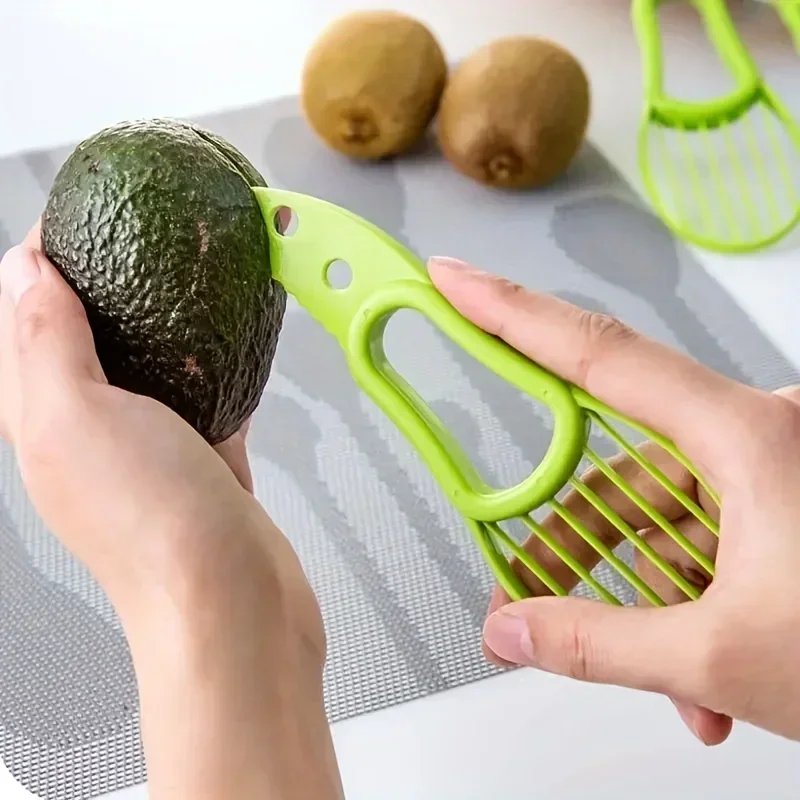
A dedicated avocado tool like the 3-in-1 avocado slicer combines three jobs into one handle: a serrated cutter for halving, a pitting head for the pit, and a curved scoop for the flesh. The safety logic is simple. The tool is shaped around the avocado, so your hands never brace the fruit against a sharp blade.
Halving with the serrated edge works like a small saw rather than a chef’s knife, so it is far less likely to glance off the skin. The pitting head grips instead of stabs, removing the entire category of miss-and-slip injuries. The scoop replaces the paring knife at the cubing stage entirely – lift the flesh out in one piece and slice it on the board, away from your fingers.
The knife method has a structural flaw: it keeps putting your hand in the blade’s path. Our 3-in-1 avocado slicer guide walks through how each end works in practice.
Knife Users: 8 Practical Safety Tips
Prefer to keep using a knife? A sharp chef’s knife is a fine avocado tool if you respect the risks. Follow these rules and you eliminate nearly all of them:
- Keep your knife sharp. A dull blade needs more force, and force is what causes slips.
- Cut on a board, not in your hand. Set the avocado on a stable cutting board for the halving cut.
- Tuck your fingers. Curl your fingertips under so the knuckles guide the blade.
- Cut around, not down. Rotate the fruit against the blade rather than driving the blade toward your palm.
- Never strike the pit with a knife. This single habit causes the majority of avocado injuries.
- Scoop the pit with a spoon or pitting tool instead. If it resists, lever it out with the spoon.
- Scoop the flesh with a large spoon, then slice on the board. Do not score cubes inside the shell while cupping it.
- Wash the fruit first. A quick rinse and dry gives you a better grip on the waxy skin.
When a Dedicated Tool Makes More Sense
A good chef’s knife handles dozens of jobs, but an avocado tool earns its drawer space if any of these sound familiar:
- You make avocado toast, guacamole, or salads several times a week. Repetition multiplies risk.
- You have kids who help in the kitchen. A pitting head is far more forgiving than a knife lesson.
- Your grip is not what it used to be. Limited hand strength makes the knife method genuinely hazardous.
- You have already been cut once. A repeat injury to the same hand is not character-building.
Like a vegetable peeler, it removes your fingers from the equation. If avocados are a staple in your kitchen, browsing dedicated kitchen gadgets for a safer option is a reasonable move.
The Bottom Line on Avocado Slicer vs Knife Safety
A knife works, but the standard knife method bakes risk into every step. The slicer removes the two most dangerous moments – stabbing at the pit and scoring the flesh in your palm – and does that job well.
Whichever tool you choose, the core principles are the same: keep the blade away from the hand that holds the fruit, never strike the pit with a knife, and do your cutting on a board. Follow those rules and avocado prep goes back to being the easy part of the recipe.
Frequently Asked Questions
What is avocado hand?
It is the nickname for a deep cut to the palm or fingers from a knife slipping during avocado prep, landing in the hand holding the fruit. These cuts often need stitches.
Is an avocado slicer actually safer than a knife?
Yes, at the two riskiest steps: a gripping pitting head replaces the knife-strike pitting method, and a scoop replaces in-shell scoring, so your hands spend far less time in the blade’s path.
Can I just use a spoon instead of buying a tool?
Yes, mostly. A spoon handles pitting and scooping safely – the two highest-risk steps. You still need a blade for halving, so pair it with careful knife technique.
Why is removing the pit the most dangerous step?
The pit is smooth, hard, and rounded, so blades glance off it easily – and the standard method braces the fruit in your palm directly behind the blade’s path, so any slip lands in your hand. A pitting tool grips instead of stabbing.
Do I need a sharp or dull knife for avocados?
Sharp. A dull knife needs more force, and extra force turns a small slip into a deep cut. Keep your knives honed regardless of how you prep avocados.
How should I store an avocado slicer?
Wash and dry it after each use, and store it with the blade edge facing away from where your fingers land when you reach in. It is still a blade, so treat it like any cutting tool.