
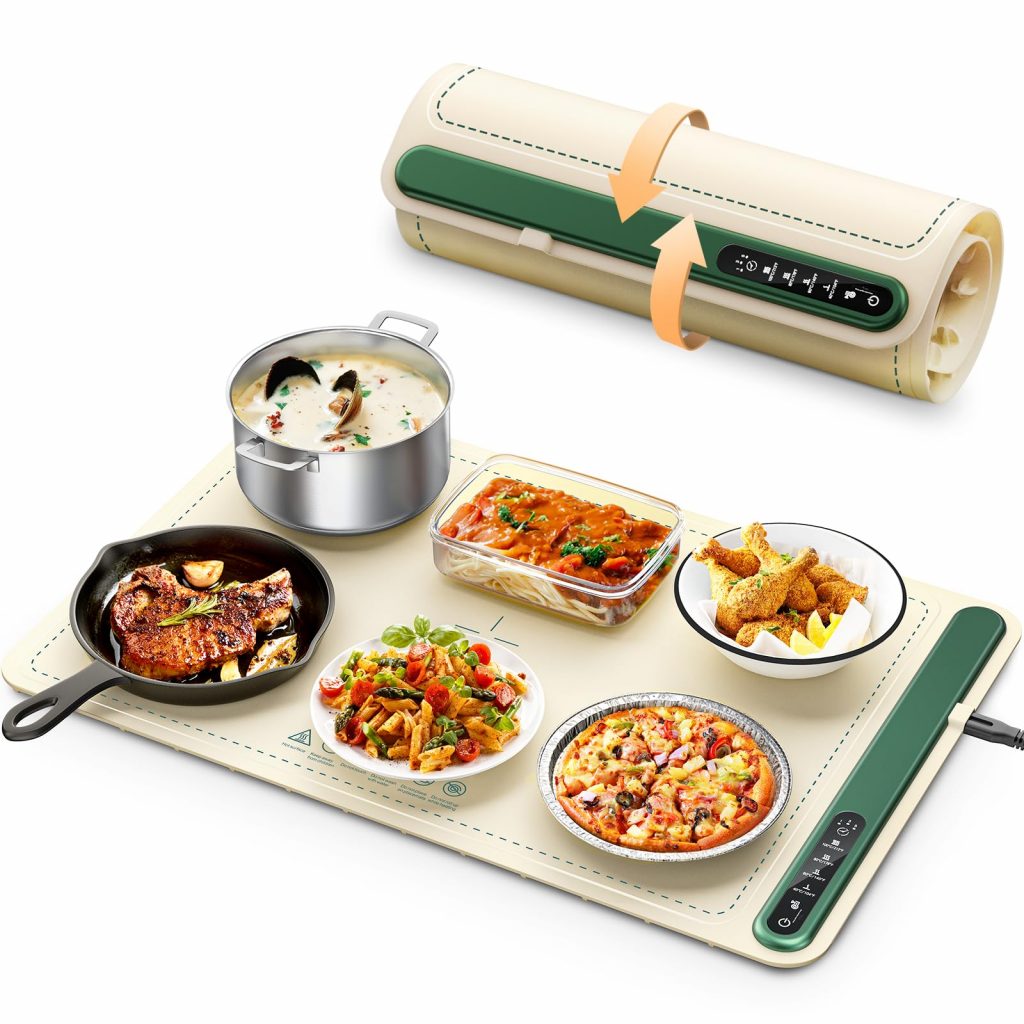
If you are planning a buffet and want the last guest in line to get food as hot as the first, you have two main options: an electric warming mat or a traditional chafing dish. Both keep party food warm, but they work in very different ways. This head-to-head comparison covers temperature control, safety, setup, cleanup, and cost so you can pick the right one for the way you host.
How Each One Keeps Food Hot
An electric warming mat is a flat, flexible silicone mat that plugs into a wall outlet. You lay it on the table or counter, set your serving dishes on top, and it delivers gentle, even heat from below. Most home models are large enough to hold two or three serving dishes side by side.
A chafing dish is a metal frame that holds a water pan with a food pan on top. Underneath the water pan sit one or two chafing fuel cans – small tins of gel fuel that you light with a match. The flame heats the water, and the hot water keeps the food above it warm. A standard fuel can burns for about two hours, so longer parties need spare cans on hand.
Temperature Control: Warming Mat Wins
Electric warming mats usually offer a few heat settings – for example low, medium, and high – so you can match the heat to the dish. Electric heat is steady from the moment you switch it on until you switch it off. There are no flare-ups and no slow fade as fuel runs out.
A chafing dish runs on a fixed flame. You cannot turn it down for a delicate sauce or turn it up for a tray of meatballs. Drafts from an open door or an air conditioner vent can make the flame flicker and create hot spots, while a still room can let the water pan get hotter than you want. And once the fuel can burns out, roughly two hours in, the food starts cooling unless someone swaps in a fresh can mid-party.
Safety: Open Flame vs a Cord
This is the biggest difference for most hosts. A chafing dish uses a real open flame sitting under a pan of hot water on a crowded table. Guests reach across it, sleeves dangle near it, and children and pets move around it. Spent fuel cans stay hot after the flame goes out and need careful handling.
A warming mat has no flame at all, which removes the single biggest buffet hazard. Its risks are the ordinary electrical kind: the cord should run along the wall or under the table edge so nobody trips over it, and the mat should sit on a dry, stable surface. There is nothing to light, nothing to blow out, and nothing for a sleeve to catch on.
Setup and Cleanup
- Warming mat: unroll it, plug it in, and set the dishes on top. That is the whole setup. Cleanup is a quick wipe with a damp cloth once it cools.
- Chafing dish: assemble the frame, fill the water pan without sloshing, place the food pan, position the fuel cans, and light them. After the party you wash the pans, wipe down the frame, and dispose of the spent fuel cans.
If you host often, the difference adds up. A mat is ready in about a minute, while a chafing dish takes ten to fifteen minutes of assembly before you even start plating food.
Cost Per Use
A warming mat is a one-time purchase, and the running cost is tiny. As an example, running a mat for a four-hour party typically costs only a few cents of electricity – far less than the price of a single fuel can.
A chafing dish needs fuel every time you use it. Each dish needs one or two cans per event, and for a four-hour party you may need a second round of cans after the first set burns out. The cans are a recurring cost for every party, and if you do not own the dishes you are paying rental fees on top.
Portability and Storage
A warming mat rolls or folds up and slides into a drawer or a cupboard. A chafing dish set – frame, water pan, food pan, lid, plus a box of fuel cans – needs a full shelf. For apartment hosts, the storage difference alone can decide it.
When a Chafing Dish Still Wins
The chafing dish keeps one clear advantage: it works anywhere. An outdoor wedding, a park pavilion, or a backyard with no outlet nearby is exactly where flame beats cord. Caterers also favor chafing dishes because staff can service a row of identical dishes, and the lidded pans suit events where food sits out for many hours. If your party has no reliable power at the buffet table, the chafing dish is still the right tool.
The Verdict: Pick by Your Party
- Indoor home buffet with an outlet nearby: the warming mat wins on temperature control, safety, setup, cleanup, cost, and storage.
- Outdoor event or no power at the table: the chafing dish wins, because it needs no electricity.
- Big catered event with staff on hand: chafing dishes scale better when a team is managing the line.
For the typical host – a holiday dinner, a birthday spread, a game-day buffet – the electric warming mat is the simpler, safer, and cheaper way to keep every dish hot from the first guest to the last. If you want to see how to set one up for a real party table, read our guide to keeping party food warm with an electric warming mat. You can also browse our kitchen gadgets collection, including the electric silicone warming mat made for buffet-style hosting.
Frequently Asked Questions
Can I use a warming mat if there is no outlet near the buffet table?
You need power within the cord’s reach. A heavy-duty extension cord rated for the mat’s wattage works fine – just run it along the wall so nobody trips. If there is genuinely no power at the table, a chafing dish is the better choice.
Is a warming mat safer than chafing fuel around kids and pets?
Yes, mainly because there is no open flame. There is nothing to knock over and nothing to catch fire. Keep the cord out of reach and the mat on a stable surface, the same as any countertop appliance.
How long can a chafing dish keep food hot?
About two hours per fuel can, which is the standard burn time for chafing fuel. For longer events, plan on swapping in fresh cans – keep spares ready and assign someone to watch the flames.
Can I put any serving dish on a warming mat?
Use oven-safe or heat-safe dishes: ceramic, metal, and heat-rated glass work well. Avoid thin plastic serving ware that can warp, and do not slide a dish straight from the freezer onto a hot mat – the sudden temperature change can crack glass or ceramic.
Will a warming mat keep cooking the food?
No – a warming mat holds food at serving temperature rather than cooking it. That said, hours of heat will dry out uncovered dishes and soften crisp textures, so keep lids or foil on trays and stir sauces now and then.
Can I use a warming mat outdoors?
Only in dry, sheltered conditions with a weather-safe outlet, such as a covered patio. Electric mats and rain do not mix. For an open-air event, a chafing dish is the safer bet.