
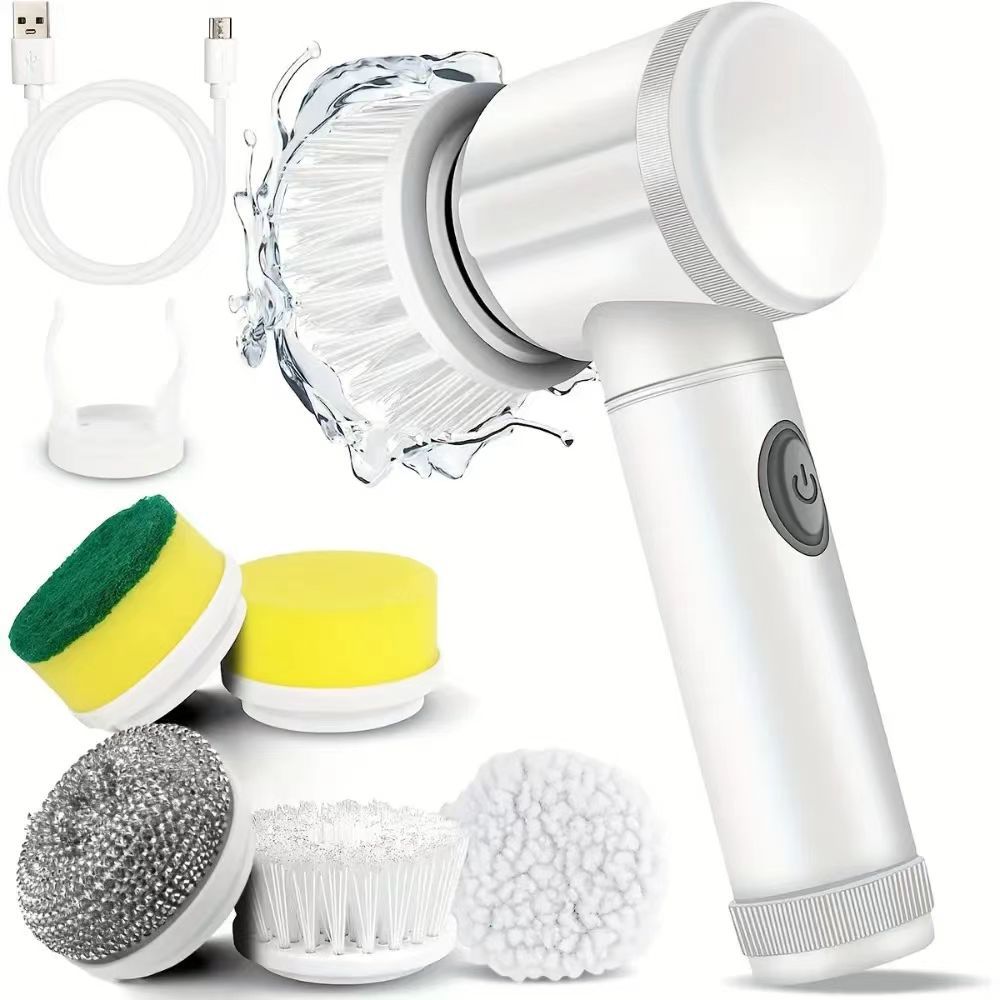
If you have ever stared at grey grout lines between bathroom tiles and wondered whether anything short of a full remodel would fix them, an electric scrubber for bathroom tiles is worth a look. Tile itself cleans up easily, but grout is porous, corners are tight, and shower glass holds onto soap scum like glue. A cordless electric scrubber with interchangeable brush heads does the mechanical work your hands cannot sustain – it spins or oscillates a brush at a speed that lifts grime in minutes rather than the twenty-plus minutes of manual scrubbing the same area might take (illustrative time, results vary by buildup).
Why Bathroom Tile Needs Its Own Tool
Kitchen counters wipe clean. Bathroom tile fights back. Here is what makes the bathroom uniquely stubborn:
- Grout is porous. Cement-based grout soaks up shampoo, hard-water minerals, and mildew spores. Surface wipes do not reach what is embedded in it.
- Moisture never leaves. A shower cubicle stays damp for hours, which feeds soap scum and mildew colonies right back after a “clean.”
- Geometry works against you. Tile corners, the tub-to-wall seam, faucet bases, and drain grates are all hard to reach with a full-size brush and even harder with a sponge.
- Manual scrubbing is exhausting. Grout needs pressure plus repetition. Most people quit long before the grout is actually clean.
An electric scrubber solves the repetition problem mechanically: consistent brush speed and pressure for as long as the battery lasts, without your wrist giving out.
Match the Brush Head to the Surface
A five-head set is not a marketing gimmick – each head exists because a different bathroom surface demands different stiffness and contact shape. Here is how to assign them (example configuration; check your model’s head names before buying):
| Surface | Recommended head | Why it fits |
|---|---|---|
| Grout lines | Narrow cone or corner head | Gets into the recessed channel between tiles where a flat brush rides over the top |
| Flat wall and floor tile | Large flat brush | Covers area quickly; stiff enough for film, soft enough not to scratch glaze |
| Shower glass and mirrors | Soft sponge head | Non-abrasive for glass; works with a light limescale remover for water spots |
| Tub rim and faucet base | Small round brush | Wraps around curves and fixtures where flat heads cannot make contact |
| Tile corners and caulk lines | Detail/crevice head | Reaches the 90-degree joint where mold starts first |
The rule of thumb: start with the softest head that does the job, and step up in stiffness only if residue remains. Glazed ceramic is forgiving, but natural stone tile (marble, travertine) and acrylic tubs scratch – on those, use only the softest heads.
The Cordless Advantage in a Wet Room
Corded scrubbers are cheaper for a reason: dragging a cord around a wet bathroom is awkward and, near an outlet with wet hands, genuinely risky. A cordless electric scrubber for bathroom tiles removes the outlet from the equation entirely.
- Reach without contortion. Behind the toilet, the far shower corner, the top row of wall tiles – no cord snagging on the towel rail.
- Extendable handles. Most sets include a length-adjustable pole, so floor grout and high shower walls get scrubbed standing up instead of on your knees.
- Rechargeable convenience. A full charge (illustrative example: around 1-2 hours of runtime depending on model and head load) is plenty for a whole bathroom, and usually more than one session.
Look for an IPX-rated water-resistant body if you plan to use it inside the shower. Splash-proof is enough for damp surfaces; do not submerge the motor housing.
Electric vs Manual Scrubbing: An Honest Comparison
| Factor | Manual scrubbing | Electric scrubber |
|---|---|---|
| Time for a standard shower cubicle | 25-40 minutes of hard effort (illustrative) | 8-15 minutes at a comfortable pace (illustrative) |
| Grout penetration | Good until your arm tires – usually about five minutes in | Consistent brush speed from start to finish |
| Shower glass clarity | Streaks common; pressure is uneven | Even passes with a soft sponge head reduce streaking |
| Physical effort | High – wrist, shoulder, and back strain | Low – guide the head and let the motor work |
| Upfront cost | A few dollars for brushes | A five-head set runs roughly in the mid double digits (illustrative price range; check current listings) |
Manual wins on price. Electric wins on consistency, speed, and the simple fact that a tool you do not dread using gets used on schedule – and regular light cleaning beats heroic deep cleans every time.
A Simple Bathroom Tile Cleaning Routine
- Pre-rinse with hot water. Loosens surface soap film so the scrubber works on embedded grime, not the top layer.
- Apply cleaner and let it dwell. For grout, a paste of baking soda and water or a commercial grout cleaner; give it 5-10 minutes (illustrative). For glass, a limescale remover with short dwell time.
- Scrub grout lines first with the corner head, moving along the grout channel rather than across it.
- Switch to the large flat head for wall and floor tile, working top to bottom so dirty water runs down onto uncleaned areas.
- Finish glass with the sponge head using light pressure, then rinse and squeegee.
- Rinse heads and air-dry. Mildew grows on a damp brush stored in a damp bathroom – pull heads off the handle and let them dry between uses.
What to Check Before Buying
- Head variety. A set with only one flat brush cannot do grout lines or corners. Five heads covers the full bathroom.
- Handle length. An extendable pole (illustrative example: 25-50 inches) reaches shower heads to floor drains without kneeling.
- Battery life. Enough for at least one full bathroom per charge – verify the runtime claim for the model you consider.
- Water resistance. The body should be rated to survive splashes; the heads themselves are fully washable.
- Charging method. USB-C charging is the most convenient; proprietary docks are one more thing to lose.
If you want to see how a full multi-head set performs in practice, our earlier walkthrough on the 5-head electric cleaning brush set and how to scrub smarter, not harder covers head swaps and technique in more detail.
Frequently Asked Questions
Will an electric scrubber damage grout?
No, when used with the correct head. Grout is cement-based and hard; a narrow corner head at moderate pressure lifts embedded dirt without eroding it. Avoid aggressive wire or ultra-stiff heads on grout, and never grind on cracked or crumbling grout – repair that first.
Can I use it on shower glass without scratching?
Yes. Use the soft sponge head with a limescale or glass cleaner, and keep pressure light. Never use stiff bristle heads on glass or mirrors; grit trapped in bristles is what scratches, so rinse heads before switching surfaces.
Does it work on moldy caulk lines?
It helps with surface mildew on caulk, and the detail head reaches right into the seam. But caulk is softer than grout, so use the softest effective head, and know that deeply stained or deteriorated caulk may need re-caulking rather than more scrubbing.
How often should I scrub bathroom tile with it?
For a daily-use shower, a quick weekly pass (illustrative suggestion: 10-15 minutes) with the flat and corner heads prevents the buildup that makes quarterly deep cleans miserable. Hard-water areas may need the glass pass twice a week.
Can one scrubber handle both bathroom and kitchen?
Yes – that is the point of interchangeable heads. Keep a dedicated soft sponge for glass and mirror duty so no grease or grit transfers between rooms. Browse the full range in our kitchen gadgets collection to see where a multi-head scrubber fits your routine.
Is cordless powerful enough for heavy soap scum?
For routine and moderate buildup, yes. For years of neglected soap scum, let a dedicated remover dwell first, then scrub – the motor provides agitation, not magic. Two shorter passes beat one marathon session.
The Bottom Line
Bathroom tile does not need stronger chemicals or more elbow grease – it needs the right brush, at the right speed, in the right shape, on a schedule you can actually keep. An electric scrubber for bathroom tiles with a proper multi-head set turns the worst cleaning job in the house into a ten-minute routine. Ready to upgrade your bathroom routine? Check out the electric cleaning brush 5-head set – five purpose-built heads, cordless convenience, and everything above in one kit.