
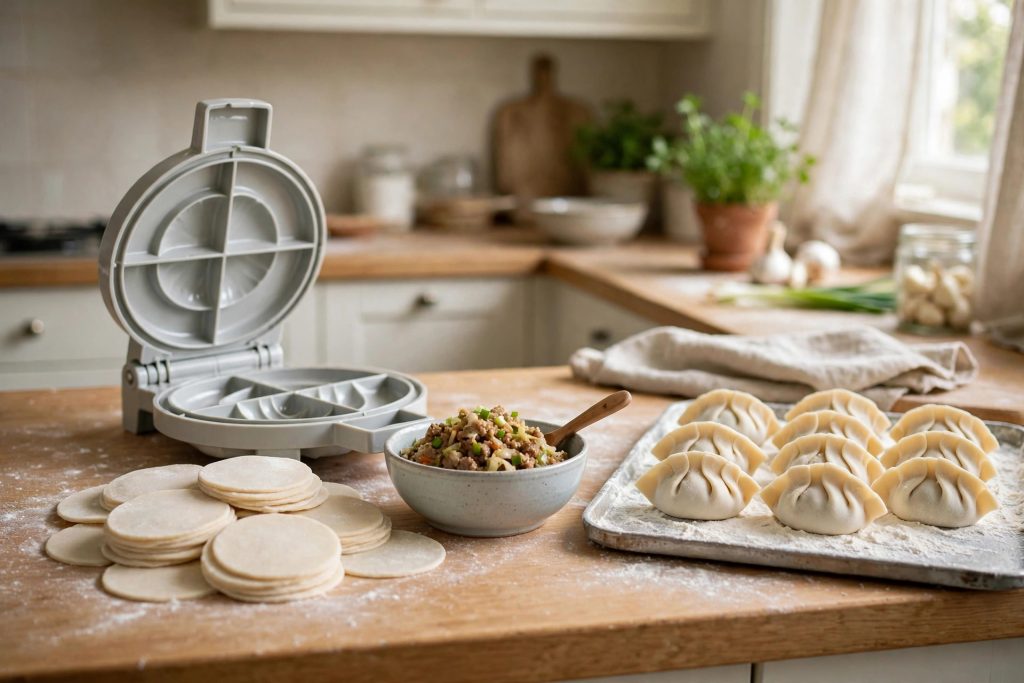
A dumpling maker for easy dumplings turns a fiddly kitchen job into a quick and tidy routine, since it presses the wrapper into shape, folds the edges together, and seals the dumpling in one smooth motion. Many home cooks love dumplings yet avoid making them from scratch, because shaping each wrapper by hand takes time and the edges often split open in the pan. A dumpling maker takes that worry away, since the mould holds the wrapper steady while you add the filling, and the press closes the edges in a neat crimp that stays shut during cooking. The result is a batch of dumplings that look alike, cook evenly, and hold their filling, which makes home made dumplings feel less like a chore and more like a pleasure. This guide explains why easy dumplings matter, how a dumpling maker works, what to look for when you buy one, how to use it well, and how to keep it clean and ready for the next batch. The maker also keeps hands cleaner, since fingers touch the wrapper less, and the bench stays tidy while the batch grows.
Why Easy Dumplings Matter
Easy dumplings matter because dumplings are a food that brings people together, and a tool that makes them simple brings that pleasure back into the home kitchen. A family that can shape a batch of dumplings in a short time is more likely to cook together, and children can help press the mould while adults fill the wrappers. Dumplings also suit many fillings, from pork and cabbage to mushroom and prawn, so a cook who can shape them fast can try new flavours without spending the whole evening at the bench. Easy shaping also cuts waste, since a wrapper that seals well keeps its filling inside the dumpling instead of leaking into the cooking water. A dumpling maker also helps cooks who are new to the dish, since the mould guides the shape and the crimp, and a first batch can look neat enough to serve to guests. When the work feels easy, cooks make dumplings more often, and a simple tool earns its place in the drawer. A cook who can shape dumplings fast can also freeze a batch for later, so a busy weeknight meal is ready in minutes. The mould also helps cooks with stiff hands, since the press does the firm work that fingers find hard.
How a Dumpling Maker for Easy Dumplings Works
A dumpling maker works by holding the wrapper in a shallow mould and pressing the edges together with a hinged press, so the shape and the seal form in one motion. You lay a round wrapper over the open mould, spoon a small amount of filling into the centre, and fold the press closed, and the edges meet in a crimped seal that holds through cooking. Most makers are a simple two part tool with a base and a hinged lid, and the mould is shaped to suit a standard wrapper, so the dumpling comes out even each time. Some makers press a plain edge, while others cut a fluted pattern that looks like a hand pleated dumpling, and both styles seal well when the wrapper is lightly damp at the edge. The tool is usually made from sturdy plastic that wipes clean, and the hinge is built to open and close many times without loosening. Once you have pressed a few dumplings, the motion becomes quick and steady, and a full batch takes far less time than shaping each dumpling by hand. A maker with a deep mould suits thick wrappers, while a shallow mould suits thin wrappers, so matching the mould to the wrapper matters.
Choosing the Right Dumpling Maker for Your Kitchen
Choosing a dumpling maker starts with the size of the wrapper you use most, since the mould must match the wrapper or the edges will not meet cleanly. Measure your usual wrappers and pick a maker with a mould that suits them, and check that the hinge closes fully without forcing the press. The material matters too, since food safe plastic that feels thick and sturdy will last longer than thin plastic that flexes under pressure. Look for a mould with a clear edge pattern, since a crisp crimp seals better and looks neater on the plate. A maker that comes in more than one size suits cooks who make both small dumplings and larger ones, and a set that nests together stores neatly in a drawer. A set with more than one size is handy for cooks who make dumplings for parties as well as for family meals. For cooks looking for everyday kitchen tools, Skyrocs offers a helpful starting point, and the pet supplies range covers daily items for homes that share their kitchen with a cat or a dog.
Using Your Dumpling Maker for Easy Dumplings
Using a dumpling maker well starts with a lightly floured bench, since a wrapper that sticks to the mould will tear when you lift the dumpling out. Lay the wrapper over the open mould and press it gently into the hollow, then add a small spoon of filling to the centre, since too much filling will squeeze out when the press closes. Dampen the edge of the wrapper with a little water, since a damp edge seals far better than a dry one, and then fold the press closed with a firm even push. Open the press and lift the dumpling out by its edge, and place it on a floured tray so it does not stick to its neighbours. Work through the batch at a steady pace, and keep the wrappers covered with a damp cloth while you work, since wrappers that dry out will crack at the fold. With a little practice, each dumpling takes only a few moments, and the batch grows fast. Press each dumpling with the same firm push, since an even press gives an even seal across the whole batch.
Cleaning and Storing Your Dumpling Maker for Easy Dumplings
A dumpling maker earns its place when it is easy to clean, since dried dough in the mould will spoil the next batch. Rinse the maker under warm water as soon as you finish, and use a soft brush or cloth to clear flour from the mould and the hinge. A little mild soap helps with sticky filling, and the maker should be dried at once with a clean towel, since water left in the hinge can dull the finish over time. Avoid harsh scourers on the mould, since scratches catch flour and make the next batch stick. Check the hinge now and then to make sure it still closes fully, since a loose hinge will not press a clean seal. Store the maker in a drawer or hang it on a hook where it is easy to reach, rather than buried under heavier pans that could bend the hinge or crack the mould. A dry maker stores best in a cool cupboard away from heat, since heat can warp thin plastic over time.
Frequently Asked Questions
Is a dumpling maker for easy dumplings needed for home cooking?
It is not needed, yet it makes shaping dumplings far faster and neater, so cooks who make dumplings often will find it worth the drawer space, while cooks who make them rarely can manage by hand. A maker also speeds up the work when cooking for guests, since a large batch takes far less time than shaping by hand.
How does a dumpling maker for easy dumplings work?
You lay a wrapper over the mould, add a small spoon of filling, dampen the edge, and fold the press closed, and the mould shapes the dumpling and crimps the edge in one motion.
Can a dumpling maker for easy dumplings handle different fillings?
Yes, it suits meat, vegetable, and seafood fillings alike, as long as the filling is finely chopped and you add only a small spoon, so the edges can close and seal cleanly.
How do I clean a dumpling maker for easy dumplings after use?
Rinse it under warm water at once, clear flour from the mould and hinge with a soft brush, use a little mild soap for sticky filling, and dry it fully before you store it.
What should I look for when buying a dumpling maker for easy dumplings?
Look for a mould that matches your wrapper size, thick food safe plastic, a hinge that closes fully, a clear edge pattern for a neat crimp, and a size that stores easily in your drawer. A maker that comes with a spare size is a bonus, since it lets you shape both small and large dumplings with one set.